
Fat Pills vs Fit Pills - Busting the Myth of the Quick Fix!?
By Will Watt, Director of State of Life
The GLP-1 ‘fat pills’ work to make you thinner, but the effects don’t last, and they make you weak. Fit pills are longer lasting, more cost effective and make you strong.
Something doesn’t stack up - let’s get ready to rumble.
“If physical activity was a pill then every doctor in the UK would be prescribing it,” declared Sir Simon Stephens, CEO of NHS England (2014-2020) at a 2016 UK Active conference.
Indeed, the 2025 NHS strategy calls for a shift from ‘sickness to prevention’ and from ‘hospital to community’. So why, in the battle against obesity, is the NHS prescribing ‘fat pills’ (semaglutides, aka GLP-1s, Wegovy, Ozempic and Mounjaro) at a yearly cost of £3,000 per patient? Especially when NICE ( the National Institute for Health and Care Effectiveness), the public body responsible for assessing whether the drugs work, states:
And while there’s plenty of anecdata out there on these treatments, we like to dig deeper. So in Manchester, GM Active and State of Life collaborated on an evidence-backed study to help us understand this sector better.
At the weigh in…the drugs do make you thinner but make you weaker, don’t last and are very expensive.
The drugs do work: up to 15% of body weight can be shed, which is reported to be more than exercise and diet programmes alone. However, the drugs come with a significant financial cost - £3,000 per person, per year - a host of known side effects, and concerns over long-term use.
Only last week (June 2026) we heard of a new drug to combat the “muscle decline” side effect of the GLP-1 drugs. So another drug to combat the side effects of the first drug…have we gone mad?
What is the NHS / NICE saying about the fat pills?
The clinical trials are strong, and the results are very positive - there is no getting away from that. But the committee recommendations for semaglutide use also make a number of pointed observations:
1. There is no evidence that fat pills work beyond one or two years
The Nice guidelines state: “3.12 Semaglutide is limited to 2 years because of restricted time in specialist weight management services and lack of evidence for longer use”. Indeed, paragraph 3.13 of the same chapter states that after stopping the medication, a person is likely to return to the weight they were at the start. Furthermore, it notes:
“The average weight for people taking semaglutide would be in line with what it would be in the average population in the diet and exercise treatment arm after 5 years”.
A study that synthesises all the trials of the GLP-1 drugs is even more cautious, with a headline suggesting that after stopping the drugs, you return to your original weight within a year and that the weight returns “four times faster” than a diet. This means that you may well need to take the drugs forever, at a very significant costs to you or the NHS.
2. Fat pills are expensive at over £3,000 a year
The EMC guidelines state that the list price of semaglutide (Wegovy) 2.4 mg is £175.80 per pack and each pack contains one pen that delivers four doses, or £64 a dose. The guidance states, “Your doctor will instruct you to gradually increase your dose every four weeks until you reach the recommended dose of 2.4 mg once weekly”.
So that’s £64 a week, or £3,328 per person, each year. And as above, after 2 years, you are highly likely to return to the weight you started at.
3. Side effects are real and the pills make you weaker
These side effects are described in the NICE report as ‘very common’ (reported by more than 1 in 10 users):
headache
feeling sick (nausea)
being sick (vomiting)
diarrhoea
constipation
stomach pain
feeling weak or tired.
And finally, “not known (frequency cannot be estimated from the available data) is bowel obstruction. A severe form of constipation with additional symptoms such as stomach ache, bloating, vomiting etc.” Alarmingly, we can already see drugs being handed out to deal with the side effects of “muscle loss” . And how are patients reporting muscle loss if the drugs are only used alongside diet and exercise as prescribed?
4. The drugs are to be prescribed alongside diet and exercise, but this doesn’t seem to be enforced?
“3.3 The marketing authorisation for semaglutide specifies that it should be used as an adjunct to a reduced-calorie diet and increased physical activity (see section 2.1)” NICE recommendations are as follows: there is no evidence of effectiveness if semaglutide is used as a single stand-alone treatment. Also, the marketing authorisation specifies use as an adjunct to a reduced-calorie diet and increased physical activity.
And yet pills and jabs are being offered at supermarkets with a cursory mention of physical exercise and a healthier diet. Is anyone policing this? While we can see that drugs + lifestyle change is better than lifestyle change alone, we can’t strip out the relative impact of either from the NICE analysis and reports.
Fit pills: complementary, more cost-effective, longer lasting and making us all stronger.
Filling the gap in evidence for physical activity and prevention
The drug companies have big budgets to run randomised, double blind control trials that cost a lot of money (into the millions). Preventative health, where the whole objective is to avoid these big treatment costs / revenues, doesn’t get the same investment in evidence. It is a perverse situation at a time when the NHS wants to make a big shift from treatment to prevention.
And so the NICE guidance for physical activity identifies gaps in evidence for exercise referral around the cost-effectiveness and the short and long term wellbeing effects (they call this the ‘feel good’ factor). We wanted to start to fill this gap.
Greater Manchester, Wigan, Burnley, Ribble Valley and the consistent evidence for the Fit Pills.
Working across eight boroughs of the devolved health authority in Greater Manchester, we collected data from over 2,000 adults going through exercise referral programmes in local leisure centres. This is referral by GPs, physios, healthcare specialists, as well as people referring themselves for health benefits in their community. Data was also collected from a control group of over 1,000 adults who were on the waiting list.
We collected data using consistent, validated measures, including the EQ-5D and ONS4 wellbeing questions, alongside key demographics to enable accurate quasi-experimental regression analysis. This enabled the use of the NHS measure of economic value - the QALY and the new HM Treasury unit of wellbeing the WELLBY. More on this here: https://www.stateoflife.org/news-blog/2024/10/4/whats-a-wellby-and-what-is-it-worth
Here is the summary of the results comparing participants in the exercise referral to the control group on the waiting list:
GM Active’s physical activity referral programmes are delivering powerful annual benefits per person, valued at £21,800 in wellbeing gains based on HM Treasury’s WELLBY measure, and £5,600 in health improvements using the NHS or NICE QALY measure.
This sort of outcome would be considered excellent value by the NHS if delivered at a cost under £1,200 per participant, per year - early estimates in the GM Active study suggest the costs per participant could be under half this figure. But more work needs to be done here.
Self reported GP consultations fell by 19% among participants, further signalling the programme’s potential to relieve pressure on NHS frontline services.
Using HM Treasury-approved wellbeing valuation methods, this converts into a social value of £21,800 per person per year, placing GM Active’s impact well above most comparable health or physical activity interventions.
These effects are especially pronounced for those with typically lower baseline wellbeing: those who are inactive, living with disabilities, or from deprived areas.
Frequent, supervised, and sustained participation is most strongly associated with health and wellbeing gains; at least 4 sessions a week is optimal.
Key benefits are evident both during and after participation and are not limited to a particular moment in the programme lifecycle.
These findings make the case for expanding and embedding exercise referral schemes as a core component of preventative healthcare. They also support GM’s wider ambition to create a population health system that reduces inequality, boosts wellbeing, and reduces pressure on public services.
And more recently this study has been replicated across the East Lancashire Leisure Trusts of Burnley, Hyndburn, Pendle, Ribble Valley Borough Council, and Rossendale. With similarly positive outcomes and lasting effects.
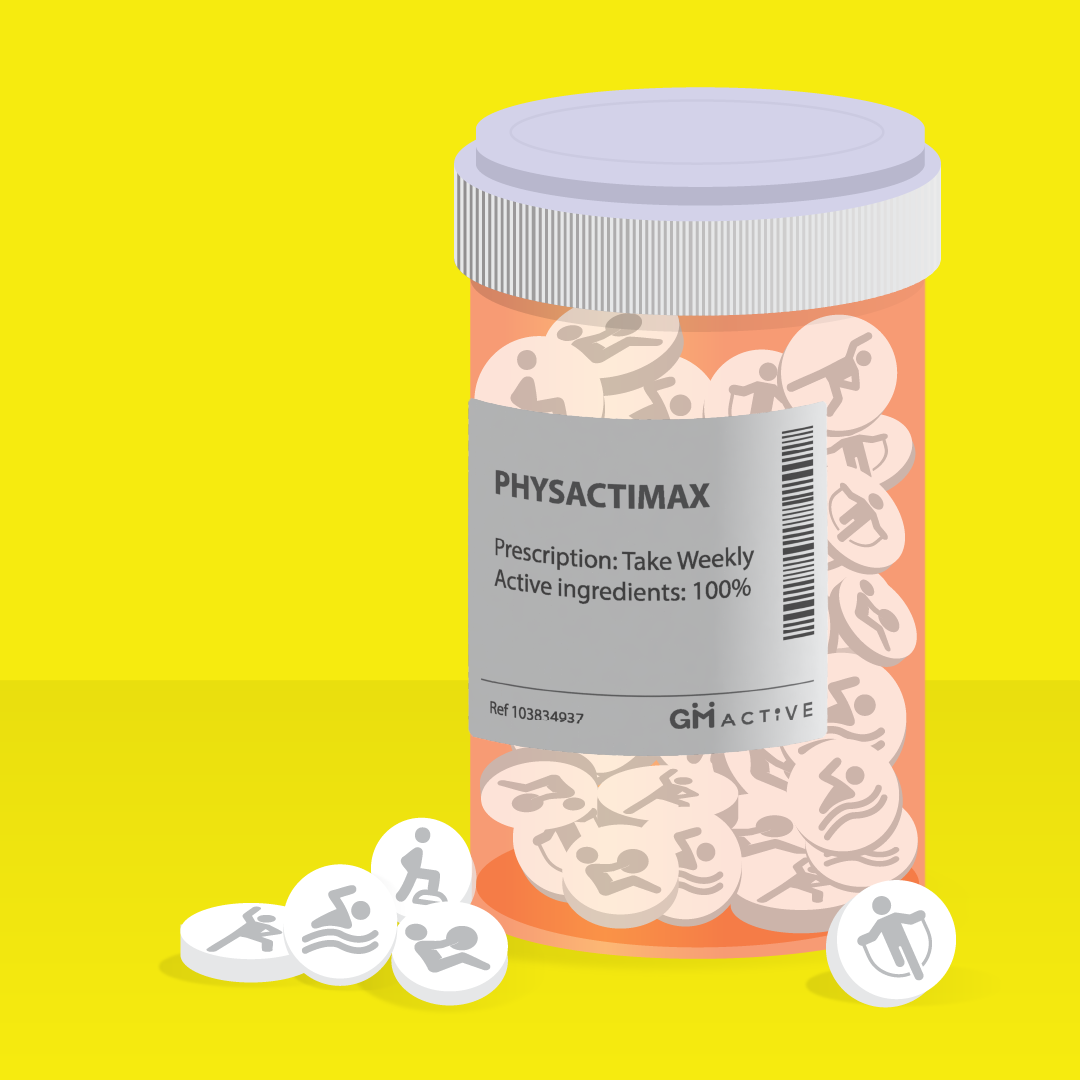
Activity is a lasting treatment with positive side effects
These early findings are consistent with two previous studies we did on a smaller scale in Essex with Sport for Confidence and in Stockport for Life Leisure. Same intervention, similar group of people, similar scale of benefits and value. We can see in the study that the health benefits also come with positive side effects - people feel better about themselves and less lonely. There is nothing, no evidence at all on whether the Fat Pills make you feel better or a bit worse about yourself - quite a gap!
Whisper it, but the fit pills probably work over the short and long term, the silver bullet that Simon Stephens refers to at the top of this blog.
And stronger people is good business
It seems that good health is also good business, with 80% of GM Active participants saying they plan to stay physically active over the next 6 months, and 66% intend to continue as ‘customers’ at their leisure centre. This suggests many participants transition from being funded referrals to self-sustaining members, contributing directly to the financial viability of the service providers.
In the NHS shift from sickness to prevention, perhaps we need to stop believing the hype of quick-fix treatments?
Admittedly, our work to date is not a double blind randomised control trial - only a big drug company can afford that. And this is one of the key reasons why the NHS is dominated by drugs and treatments and why the NHS needs a shift from ‘sickness to prevention’ and from ‘hospital to community’.
There are, throughout history, great examples of drugs providing huge leaps in health (Aspirin, The Pill, Penicillin and many vaccines). We’re not anti-drugs. But when you see Eli Lilly (the company producing Mounjaro) saying ‘Obesity is a disease’ when it’s only been around for a couple generations, you start to feel uncomfortable. And you start to see the motivations of offering quick fixes, for big profits and the side effects offloaded onto the state.
We’re hoping our study can start to change that. For us, this is Round 1 in what might be a contest that goes a few rounds. But as they say in the fight game…“It's not whether you got knocked down; it's whether you get back up.”
Seconds out…