

Sing Hallelujah - what Churches should shout about.
To get a real Quiet Revival we need a Loud Recital?
By Eddie Hillier, Economist and Data Analyst at State of Life
A mis step by the Bible Society creates an opportunity
There has recently been debate about the existence of a ‘quiet revival’ in church attendance in the UK, mainly driven by an influx of younger people. The claim was based on polling carried out by YouGov, and written up in a report by Bible Society.
Other data sources, such as the British Social Attitudes Survey (BSA), paint a different picture. Analysis from the Pew Research Center points to church attendance going down, rather than up. For example, the proportion of young people (aged 18-34) identifying as Christians who attend church at least monthly fell from 8% to 6% between 2018 and 2024.
Scrutiny has led to YouGov pulling their data amidst concerns of possible issues with the survey’s sampling methods and response quality.
What definitely is on the rise is churches providing community care through foodbanks, combatting loneliness, and much more
A church building is very important in enabling people to attend religious services - and our research indicates that this alone is beneficial for our wellbeing - but it is also much more.
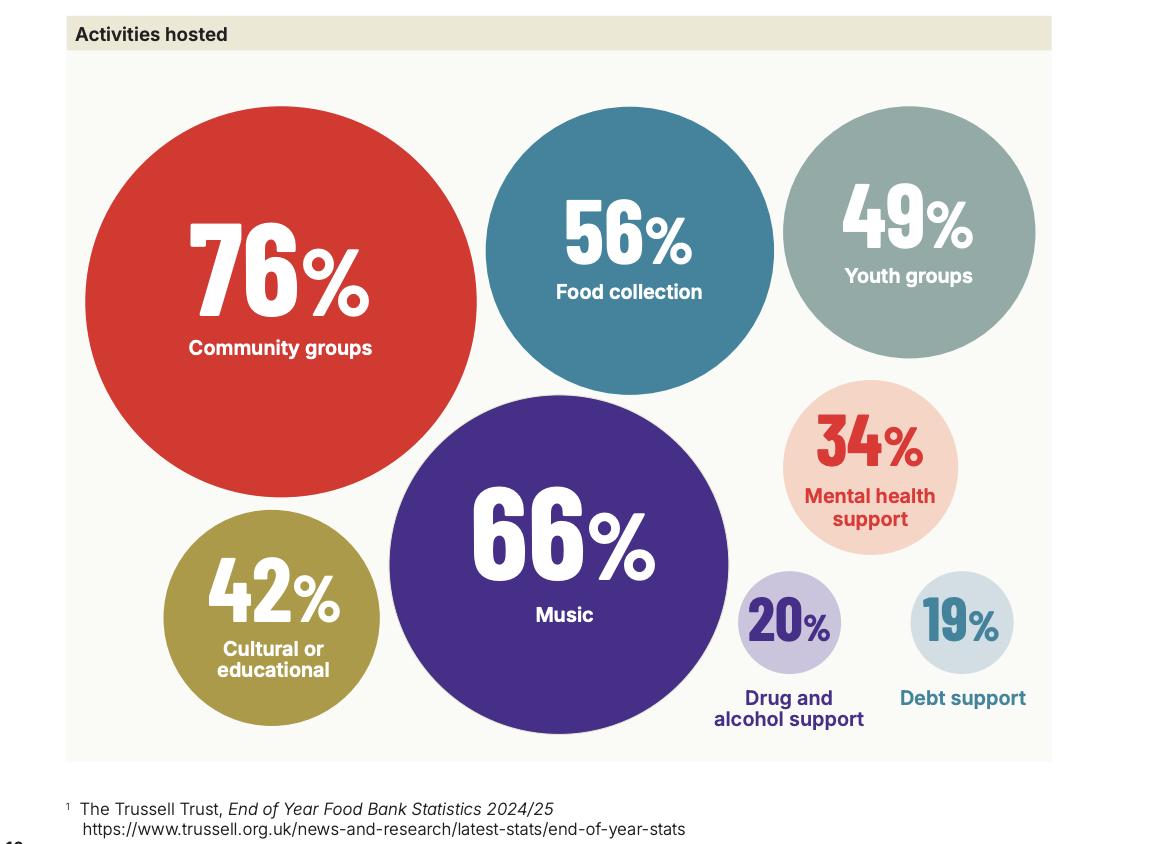
The church is a vital hub for the wider community, often providing frontline support in social care. Last year, The National Churches Trust ran a survey to find out what services churches are running, updating the survey of 2010 and 2020. Summarising their results, we can see a huge expansion in provision, for example :
Food banks were not around in 2010 but now nearly 60% of churches have some form of collection.
Drug and alcohol support has gone from 9% to 20% in 15 years.
Mental Health support groups from 10% to over 30%.
Debt relief services have increased from 5% of churches in 2010 to 19% in 2025.
Source: National Churches Survey Full Report
We can see that churches run a huge range of activities, from community and youth groups to debt support for those facing financial insecurity. Underpinning these services are the many volunteers who give up their time to keep them running. They often form the bedrock of operations; the same survey found that 83% of churches say that volunteering is a central part of the management of their buildings.
What Bible Society could be saying

Almost everything about and around a church and the services they provide is good for our quality of life, welfare, and health. Religious attendance, volunteering, and participation in community services are linked to improvements in how we feel.
The House of Good
Our work with the National Churches Trust has emphasised the good that we should shout about. The original House of Good Report sought to estimate the ‘halo of value’ that church buildings can provide, incorporating financial benefits, replacement costs, and wellbeing values from volunteering, religious attendance, and community engagement. The estimated value came to at least £12.4 billion across the UK. Our House of Good update in 2021, utilising updated HM Treasury guidance, reestimated the value at £55 billion; for every £1 spent, we estimated a return of £16 in social value.
We haven’t stopped there. State of Life has explored other perspectives, viewing church buildings as a way to help relieve costs on the NHS in our House of Good Health report. The relief associated with church activities was estimated at around 4% of total NHS health spending.
Finally, we wanted to bring power to the people with a democratised social value tool. Using the House of Good Local Estimator, churches can now start to communicate their value through an easy to use, accessible tool.
The future of churches
5 years on from our first report, our work isn’t over. Rather, this research around churches is constantly being recited and renewed. Our original analysis did not include the full range of activities that church buildings may provide such as music or community groups, or other services they might convene, suggesting the value may be even higher. There may also be additional benefits relating to the heritage value which these historic assets create, as well as wider economic impacts through tourism.
Church buildings can act as a catalyst for a huge amount of good within our communities. Instead of a quiet revival, these are the things we should all be louder about.